As businesses grow, customer expectations also rise with them. Every business that is successful in its respective industry has a good customer support and service delivery department. Organizations are increasingly relying on virtual agents to scale operations, improve responsiveness, and deliver better service experiences.
However, the term “virtual agent” has become confusing nowadays. It is used to describe human virtual assistants as well as AI virtual agents.
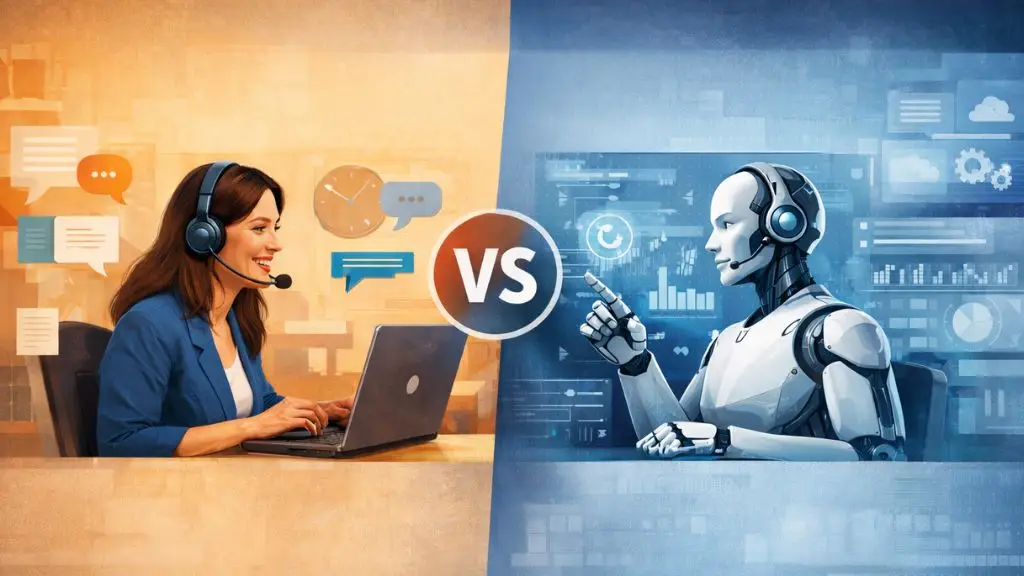
Both play an important role in modern business operations, but they serve different purposes, offer different values, and create different outcomes. This blog clearly explains how human virtual assistants and AI-powered virtual agents work together to create a high-performance model.
Two Types of Virtual Agents
1. Human Virtual assistants (live agents)
Human virtual assistants are real people working remotely as professional support staff. They are off-site employees who offer real human judgment, communication skills, empathy, and experience.
They are ideal for:
- Customer support and customer success roles – Managing real conversations, resolving issues, and building customer trust.
- Call center operations – Handling inbound and outbound calls with professionalism and consistency.
- Sales support and lead qualification – Engaging prospects, qualifying leads, and supporting conversion.
- Appointment scheduling and coordination – Managing calendars, bookings, and follow-ups accurately.
- Administrative services – Supporting daily business operations and internal workflows.
- Technical and service-based support – Assisting customers with product or service issues that require understanding and judgment.
- Account management and relationship handling – Maintaining long-term client relationships and customer satisfaction.
Strengths of live agents
- Emotional intelligence and empathy: live agents understand customer emotions and respond accordingly and appropriately.
- Relationship building: they can connect with customers and create trust-based, long-term relationships
- Complex problem solving: they can handle multi- layered, complex issues that may not be standard problems
- Brand representation: live agents act on the company’s behalf and are the acting brand ambassadors in customer interactions.
- Trust-based customer interaction: they build customer trust through real human communication.
Human live agents are essential when conversations require context, judgement, persuasion, and emotional intelligence. For businesses, they also generate higher business value, stronger revenue opportunities, and deeper engagement, making them a strategic investment.
2. AI Virtual Agents (Software-based automation)
AI virtual agents are digital systems powered by artificial intelligence, natural language processing, and machine learning. These agents automate conversation and handle structured, repetitive interactions at a large scale efficiently.
They are commonly used for:
- FAQ handling – Answering common questions instantly.
- Basic customer inquiries – Resolving simple, routine requests.
- Status updates – Providing order, ticket, or service updates automatically.
- Information retrieval – Fetching data from systems and knowledge bases.
- Simple support workflows – Managing basic support journeys.
- First-level triage and routing – Filtering and directing queries to the right teams.
Strengths of AI virtual agents:
- 24/7 availability – Providing continuous service without downtime.
- Instant responses – Delivering immediate support to customers.
- High-volume handling – Managing thousands of interactions at once.
- Cost efficiency for routine tasks – Reducing operational costs for simple workflows.
- Consistent service delivery – Providing uniform responses and processes.
- Scalability – Expanding capacity instantly as demand grows.
AI agents are excellent for speed, efficiency, and automation, but they lack emotional intelligence, human judgment, and relationship-building capability.
Human-Led Support vs AI Automation: Finding the Right Balance
To have a good customer support department, a business doesn’t have to choose between people and technology, but use them where they perform the best. AI and humans have their own strengths and pitfalls; when combined correctly, they create a powerful, scalable and high- value service model.
AI is best suited for operational efficiency and scale:
AI systems are designed to manage volume, speed, and consistency. They can handle thousands of interactions at the same time, respond instantly to customers, and operate continuously without downtime. AI excels at automating routine, repetitive tasks, such as answering common questions, guiding users through structured workflows, and processing basic service requests.
It is also highly effective in first-contact handling, where it can collect information, categorise issues, and route queries to the correct team. This reduces pressure on human agents and ensures customers reach the right support channel faster.
In short, AI brings automation, speed, availability, and operational scalability.
Human agents are essential for value creation and relationship building:
Human support teams bring what technology cannot, judgment, empathy, trust, and emotional intelligence. They manage complex conversations that require understanding context, nuance, and human behaviour. They handle emotionally sensitive situations with care, reassurance, and empathy, which is critical in industries where trust matters.
Human agents are also central to high-value interactions, including sales conversations, account management, and customer retention. They build relationships, influence decisions, resolve complex problems, and create long-term loyalty. In trust-based services, customers don’t just want answers; they want reassurance, understanding, and confidence.
Human-led support delivers credibility, personal connection, and decision-driven service, turning customer interactions into long-term business value.
The real power comes from combining both.
AI handles speed, automation, and scale. Humans deliver trust, revenue, relationships, and service quality. Together, they create a balanced support model that is efficient, human-centered, commercially strong, and built for sustainable growth.
How AI Supports Human Agents (Not Replaces Them)
AI tools can:
- Pre-qualify customer requests – Collecting key information before human engagement.
- Collect information before human interaction – Reducing repetitive questioning.
- Route conversations intelligently – Sending requests to the right agents.
- Provide knowledge support to agents – Assisting agents with data and insights.
- Automate repetitive admin work – Reducing operational workload.
- Improve response accuracy – Supporting better-quality service delivery.
This allows human agents to focus on:
- Relationship building – Strengthening customer trust.
- Problem-solving – Resolving complex issues.
- Sales conversations – Driving revenue and growth.
- Complex support – Handling advanced service needs.
- Strategic customer engagement – Building long-term value.
The Modern Virtual Agent Model
Today’s most successful businesses operate on a hybrid model that combines AI automation and human expertise, where the technology isn’t replacing humans but playing a complementary role to each other.
AI for automation and scale
AI systems handle the high-volume, high-frequency, and repetitive parts of customer interaction. They manage large numbers of requests simultaneously, automate structured workflows, and provide instant responses across channels. This creates operational efficiency, reduces service backlogs, and allows businesses to scale support capacity without increasing operational complexity.
Human agents for value, trust, and relationships
Human agents deliver what technology cannot: emotional intelligence, trust-building, persuasion, judgment, and relationship management. Their role is not just service delivery, but value creation: strengthening relationships, increasing loyalty, driving conversions, and protecting brand reputation. Together, this hybrid model creates measurable business impact:
- Faster service – AI reduces response and resolution times by handling volume and routing efficiently.
- Better quality – Human agents maintain high service standards through empathy, judgment, and expertise.
- Higher satisfaction – Customers receive fast responses and meaningful human support when it matters.
- Stronger brand perception – Service feels professional, reliable, and trustworthy across every interaction.
- Sustainable growth – Operations scale smoothly without sacrificing service quality.
- Revenue-driven support operations – Support becomes a growth engine through relationship-building, retention, and conversion.
The modern virtual agent model is not just a support strategy; it is a business growth strategy. By combining AI efficiency with human intelligence, organisations create service systems that are scalable, resilient, customer-centered, and commercially powerful.
The Hybrid Future of Virtual Agents
Virtual agents are no longer a single concept; they represent a dual model of human intelligence and artificial intelligence working together. Human virtual assistants bring empathy, judgment, trust, and relationship-building, while AI virtual agents deliver speed, automation, scalability, and efficiency. On their own, each has limitations, but together they create a powerful, balanced support ecosystem that meets both operational and human needs.
For modern businesses, the future of customer support isn’t about replacing people with technology; it’s about using technology to elevate human value. By combining human-led service with intelligent AI automation, organisations can build support systems that are scalable, high-performing, customer-centered, and revenue-driven, creating better experiences for customers and stronger, more resilient business growth for the future.
For organizations exploring this hybrid approach, partnering with a service provider that understands both human-led support and AI integration can help turn this model into a practical, sustainable growth strategy.