
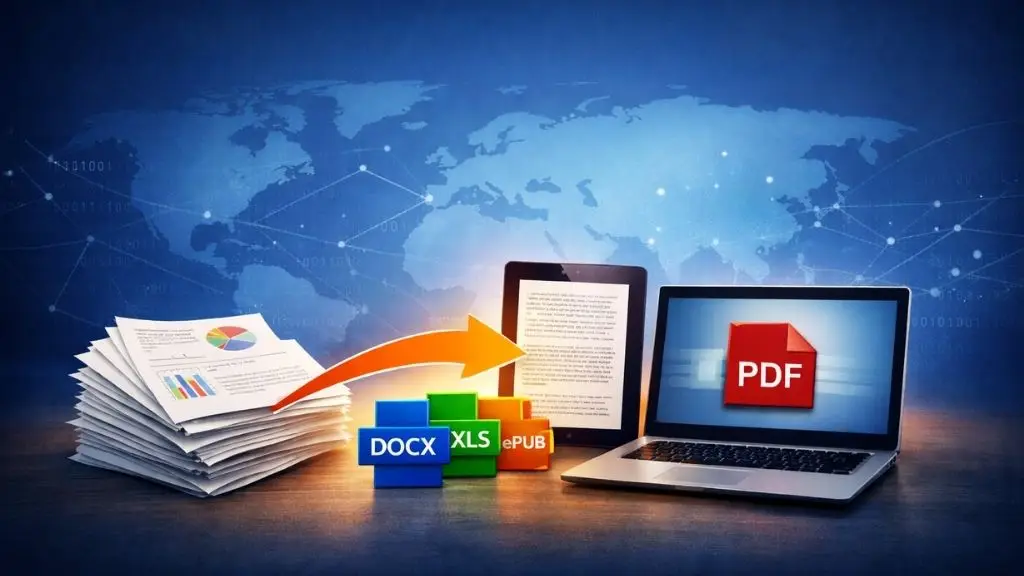
Every business collects data. Over time, that data piles up fast. Documents, forms, PDFs, scanned files, and paper records end up in different places and different formats. Getting all of that into one usable, organized system is not simple. That is where document conversion services come in. More and more companies are choosing to outsource this work rather than deal with it in-house.
This blog covers what document conversion actually involves, why businesses outsource it, and what the real benefits look like.
What Is Document Conversion?
Document conversion is the process of changing a document from one format into another. It sounds simple, but the work involved can be significant. A company might need to convert printed paper records into searchable digital files. They may also need to turn scanned images into structured database entries. Some businesses need XML to PDF conversion. Others need HTML conversion or document digitization. The scope depends on the industry and the volume of files.
At its core, document conversion is about making information actually usable. Raw data stuck in the wrong format is hard to search, share, or analyze. When it is properly converted and organized, teams can find what they need quickly. Reports are easier to generate and day-to-day work gets smoother. That is why digital document conversion has become important across healthcare, legal, finance, and eCommerce industries.
Why Companies Choose to Outsource
Handling document conversion in-house sounds manageable at first. But once the volume gets large, it becomes a real problem. You need the right software tools, trained staff, quality check processes, and secure file handling systems. Setting all of that up takes time and money. Even once it is running, it still pulls your team away from the actual work of the business.
That is why many companies turn to back office outsourcing for this kind of work. It means handing the task to a team that does this every single day. They already have the tools, the workflows, and the experience. Your internal staff can stay focused on what they do best. The work still gets done, just not by you.
Key Benefits of Outsourcing Document Conversion Services
1. Lower Costs
This is usually the first reason businesses look at outsourcing. Setting up an in-house document conversion operation is expensive. You need software licenses, scanning equipment, and people who know how to use them. Then there are training costs, salaries, and overhead on top of that.
When you outsource, you skip most of that. You pay for the service, not the equipment. There are no equipment upgrades to worry about and no software renewals. Businesses can typically save up to 60 percent on document conversion costs compared to running it in-house. For smaller companies, that difference has a real impact on budgets.
2. Access to Skilled Professionals
OCR processing, document indexing, PDF conversion, and XML structuring all require people who know what they are doing. Not every business has that expertise internally. Hiring for it is not always practical when the need is only for a specific project.
Outsourcing gives you access to specialists who handle this work full time. They understand different file formats and manage large volumes efficiently. They follow quality control steps that catch errors early. They have also seen difficult cases like handwritten records or damaged documents. A skilled team knows how to handle these without slowing down the process.
3. Faster Turnaround
A dedicated team with the right tools can process large batches of data much faster than a small internal team. This matters during system migrations or digital transformation projects where you need structured data quickly.
Many outsourcing partners also work across time zones, so the work keeps moving even when your office is closed. A job started at the end of your business day can be ready by the time your team comes back in the morning. For businesses under tight timelines, this kind of progress is very useful.
4. Better Document Quality
Poor data quality causes real problems. Missing fields, wrong formats, and duplicate records create issues later on. A bad conversion today means extra cleanup work tomorrow, and that cleanup is rarely cheap.
Experienced outsourcing providers run multi-step quality checks on converted documents. They verify outputs and review work before delivery. Some teams use double-keying methods where two operators enter the same data separately and results are compared. That level of consistency is hard to maintain when document conversion is just one of many tasks your internal team handles.
5. Improved Data Accessibility
Once documents are properly converted and organized, accessing them becomes much easier. Structured digital files can be searched and retrieved in seconds. For businesses with years of historical records, this is a major improvement. Teams can pull up a file in moments instead of spending time digging through folders or physical storage.
Better accessibility also changes how teams work together. When data is in a clean and consistent format, it is easier to share across departments. It is also easier to feed into reporting tools or other systems. This connects closely with good data cleansing practices, since converting documents is a good chance to remove outdated records at the same time.
6. Scalability Without the Stress
Document volumes are not always the same. Some months bring in far more records than others. A legal firm might have a case that creates thousands of documents at once. A healthcare provider might go through a system upgrade that requires converting years of old patient records. Scaling an internal team to match those spikes is difficult.
Outsourcing handles this more cleanly. You adjust the work based on actual need without changing your internal team. If volume increases, the provider scales up. When it drops back down, you are not paying for extra staff. That kind of flexibility is hard to build internally but very easy to access with the right partner.
7. Stronger Data Security
A professional document conversion provider will have security protocols in place. Encrypted file transfers, access controls, and non-disclosure agreements are all part of how they operate. This is not optional for them. It is a core part of the service.
Businesses in healthcare, legal, and finance sectors need to know their data is handled carefully. HIPAA compliance and GDPR requirements apply to how data is stored and transferred. A reliable partner will have the certifications and clear processes to show you. If a provider cannot explain their security setup, that is a reason to keep looking.
8. More Time for Core Work
When your team is not stuck on document conversion tasks, they have more time for work that moves the business forward. Document conversion is necessary, but it is rarely where companies create real value. It is detailed and repetitive work that needs full attention.
Getting it off your team’s plate frees up time and energy for things that matter more. Product development, customer service, and sales are the areas where your people make the biggest difference. Outsourcing the back-end work means your team stays focused on the front-end impact.
What to Look for in a Document Conversion Partner
Not every provider will be the right fit. Before choosing one, think about their experience with your specific type of data. A team that handles medical records may not be the best choice for legal documents. Ask about their process and look for examples of similar projects. Pricing should be clear from the start. Hidden fees or vague terms are worth questioning early.
Security and quality control are very important. A good partner should explain both clearly. It also helps to work with advisors who have access to global BPO agencies. Location can affect both cost and turnaround time depending on your requirements.
Future-Proofing Your Business with Digital Transformation
Outsourcing document conversion does not require a big strategy discussion. The logic is pretty straightforward. It is repetitive work that needs specific tools and trained staff. Most businesses do not have those resources sitting idle. Using internal people on document conversion is usually not the best trade-off for growth.
The benefits are real and they show up in every industry. You get lower costs, cleaner data, faster output, and better security. For companies managing large volumes of records, outsourcing document conversion services is one of the most practical decisions you can make.
Ready to turn your archives into an asset? Contact WCC today for a free consultation and let us match you with the perfect document conversion partner from our global network.