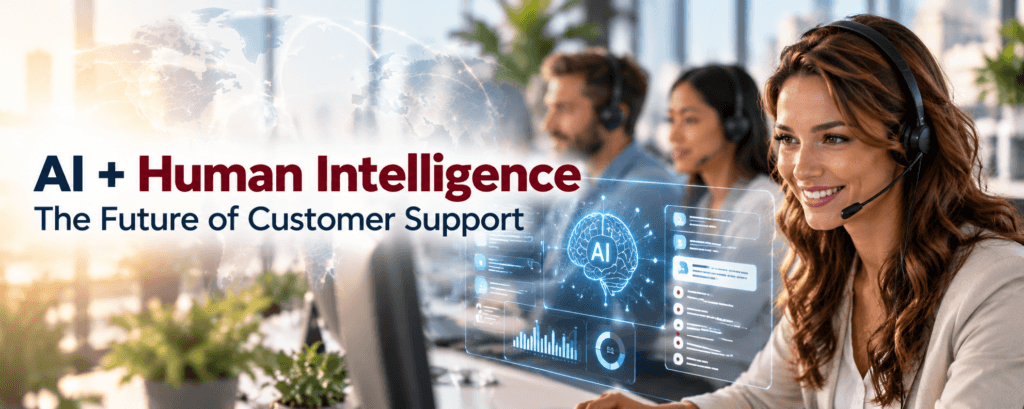
How AI-powered contact centers are transforming customer experience, reducing operating costs, and empowering human agents to deliver better service.
When I began working in the call center industry in 1992, artificial intelligence was already generating considerable discussion. Even then, business leaders were debating whether technology would eventually replace human customer service representatives.
More than three decades later, that conversation has become more relevant than ever.
Today’s AI technologies—including generative AI, intelligent virtual agents, conversational AI, predictive analytics, and automated quality management—are fundamentally changing how contact centers operate. Businesses can now automate routine customer interactions, analyze conversations in real time, and provide agents with immediate access to information that once required extensive research.
However, the most successful customer support strategies aren’t necessarily those that eliminate human involvement. They are the ones that combine the efficiency of artificial intelligence with the empathy, judgment, and problem-solving abilities of experienced customer service professionals.
At Worldwide Call Centers (WCC), we believe this combination represents the future of customer experience outsourcing.
How Artificial Intelligence Is Transforming Contact Centers
Artificial intelligence has evolved from basic interactive voice response (IVR) systems and scripted chatbots into sophisticated platforms capable of understanding customer intent, summarizing conversations, recommending solutions, and automating complex workflows.
Modern AI-enabled contact centers can improve operational performance across multiple customer communication channels, including telephone, email, live chat, text messaging, and social media.
Some of the most valuable AI applications include:
Conversational AI and virtual agents: Automating common customer inquiries, appointment scheduling, order tracking, and basic account assistance.
Real-time agent assistance: Providing customer service representatives with relevant information, suggested responses, and knowledge base recommendations during live interactions.
Predictive analytics: Identifying customer trends, anticipating service needs, and helping businesses make more informed operational decisions.
Automated quality assurance: Evaluating customer interactions to identify coaching opportunities, compliance concerns, and service improvements.
Intelligent call routing: Directing customers to the most appropriate agent or department based on their needs, language, and interaction history.
Workflow automation: Reducing repetitive administrative tasks such as data entry, case documentation, and post-call summaries.
When implemented correctly, these technologies can help businesses reduce operating expenses, improve response times, and deliver more consistent customer experiences.
But technology alone does not guarantee better customer service.
Why Human Agents Remain Essential in an AI-Powered World
One of the biggest misconceptions about artificial intelligence is that increasingly sophisticated technology will make human customer service agents unnecessary.
AI will certainly automate a growing percentage of routine customer interactions. However, many customer service situations still benefit significantly from human involvement.
Consider a customer disputing a complicated medical bill, an insurance policyholder dealing with a major claim, or a frustrated consumer trying to resolve a recurring technical problem.
These interactions often require more than an accurate answer.
They require patience, empathy, sound judgment, and the ability to understand circumstances that may not fit neatly into a predefined workflow.
Human agents provide several important capabilities:
Empathy and emotional intelligence: Recognizing customer frustration, uncertainty, and emotional concerns.
Complex problem-solving: Evaluating unusual situations and developing practical solutions.
Relationship-building: Establishing trust through meaningful, personalized conversations.
Critical judgment: Making appropriate decisions when policies, customer expectations, or circumstances conflict.
Brand representation: Communicating a company’s values, personality, and commitment to customer satisfaction.
AI systems can increasingly recognize emotional signals and produce empathetic responses. Nevertheless, businesses should not assume that automated responses are an adequate substitute for human judgment in every situation.
The objective should be to use automation where it adds value while maintaining access to skilled agents when customers need personalized assistance.
The Risks of Relying Too Heavily on AI Automation
Artificial intelligence offers tremendous opportunities, but poorly planned implementations can damage the very customer relationships businesses are trying to strengthen.
Some organizations approach AI primarily as a labor-reduction strategy, focusing on eliminating agent positions without fully considering customer expectations or service complexity.
This approach can create several problems.
1. Frustrating Customer Experiences
Customers can become irritated when automated systems misunderstand their requests, provide repetitive answers, or make it difficult to reach a live representative.
2. Inaccurate or Misleading Information
Generative AI systems can occasionally produce incorrect information, misunderstand context, or recommend inappropriate solutions.
In industries such as healthcare, financial services, and insurance, these errors can create significant operational and compliance concerns.
3. Reduced Personalization
Excessive automation can make customer interactions feel impersonal, particularly when customers are dealing with sensitive or emotionally charged situations.
4. Employee Resistance
Contact center agents may become frustrated when AI-generated scripts or recommendations limit their ability to exercise professional judgment.
AI should support agents—not prevent them from responding naturally to customer needs.
5. Data Privacy and Security Concerns
AI platforms frequently process sensitive customer information. Businesses must carefully evaluate data protection, access controls, retention policies, and applicable regulatory requirements before deploying these technologies.
The lesson is straightforward: successful AI implementation requires thoughtful planning, human oversight, and a customer-first strategy.
Six Ways AI and Human Agents Can Work Better Together
The greatest opportunity for modern contact centers lies in combining advanced technology with experienced customer service professionals.
Here are six practical ways businesses can benefit from this approach.
1. Automate Routine Customer Service Tasks
AI-powered virtual agents can handle repetitive interactions such as order status inquiries, appointment confirmations, basic troubleshooting, and account information requests.
This allows human representatives to dedicate more time to complex situations that require personal attention.
The result can be improved productivity without sacrificing service quality.
2. Provide Real-Time Assistance to Human Agents
Modern AI platforms can listen to or analyze customer conversations and immediately provide agents with relevant information.
For example, an AI assistant might retrieve a customer’s previous interactions, recommend troubleshooting procedures, or identify the next step in resolving a service issue.
Instead of searching through multiple systems, agents can concentrate on understanding the customer’s needs and delivering a helpful response.
3. Improve Agent Training and Performance
AI-enabled quality management systems can analyze customer interactions and identify opportunities for improvement.
Supervisors can use these insights to provide more targeted coaching, evaluate communication skills, and recognize successful service techniques.
AI-powered training simulations can also help new agents practice difficult conversations before interacting with actual customers.
4. Deliver Better Omnichannel Customer Support
Today’s customers expect businesses to communicate through their preferred channels.
AI can help coordinate customer interactions across phone, email, live chat, text messaging, and social media.
When these systems are integrated properly, customers can move between communication channels without repeatedly explaining their problems.
Human agents can then continue the conversation with the context needed to provide personalized support.
5. Reduce Costs While Maintaining Service Quality
One of the strongest business cases for AI is its potential to improve operational efficiency.
Automation can reduce the time agents spend on repetitive activities, accelerate case resolution, and help contact centers manage fluctuating customer demand.
However, businesses should evaluate AI investments using more than cost savings alone.
Important performance indicators include:
Customer satisfaction (CSAT)
First-contact resolution (FCR)
Average handle time (AHT)
Customer effort score (CES)
Quality assurance performance
Cost per resolved interaction
The objective is not simply to handle customer inquiries at the lowest possible cost. It is to achieve the best combination of efficiency, service quality, and customer satisfaction.
6. Support 24/7 Customer Service Operations
AI-powered chatbots and virtual agents can provide immediate assistance outside normal business hours.
For organizations requiring continuous customer support, these systems can complement live-agent teams and help manage overnight or high-volume inquiries.
When an issue becomes too complicated for automation, the interaction should transition smoothly to a qualified human representative.
This combination allows businesses to provide more responsive support while maintaining flexibility in staffing and operational costs.
Choosing the Right AI-Enabled Contact Center Outsourcing Partner
Not all contact center providers have the same technological capabilities, operational expertise, or experience implementing artificial intelligence.
Some agencies have invested heavily in AI-powered customer experience platforms, while others are still developing their automation strategies.
For businesses considering outsourcing, evaluating these differences is increasingly important.
Before selecting an AI-enabled contact center partner, consider asking:
What AI technologies do you currently use? Determine whether the provider has proven experience with conversational AI, agent assistance, automated quality assurance, and workflow automation.
How do you balance automation with human support? Make sure customers can reach qualified agents when automated systems cannot resolve their concerns.
Can your technology integrate with our existing systems? Evaluate compatibility with CRM platforms, help desk software, knowledge bases, and other business applications.
How do you measure AI performance? Look for clearly defined metrics covering customer satisfaction, accuracy, resolution rates, and operational efficiency.
What safeguards protect customer information? Review security controls, data handling practices, compliance requirements, and human oversight procedures.
Can your solutions scale with our business? The right partner should accommodate changing call volumes, new communication channels, and evolving customer expectations.
Selecting a provider based solely on the latest AI technology—or the lowest hourly rate—can be a costly mistake.
The best outsourcing partner is one that understands your business objectives and knows how to apply technology and human expertise to achieve them.
How Worldwide Call Centers Helps Businesses Find AI-Enabled Outsourcing Partners
At Worldwide Call Centers (WCC), we understand that choosing the right contact center outsourcing partner has become increasingly complex.
Businesses must evaluate not only staffing, pricing, language capabilities, and industry experience, but also the quality of each provider’s technology, automation capabilities, and approach to customer experience.
That’s where our Senior Advisors can help.
Through the WCC Network of more than 125 contact center agencies, we help businesses identify qualified outsourcing partners that align with their operational requirements, customer service goals, technology needs, and budgets.
Our advisory process includes:
Understanding your business: Reviewing customer support requirements, industry considerations, call volumes, service channels, and growth objectives.
Identifying qualified providers: Introducing a carefully selected shortlist of agencies with relevant operational expertise and capabilities.
Evaluating AI and automation strategies: Helping you compare how prospective partners integrate artificial intelligence with human customer service.
Comparing outsourcing proposals: Assisting with the evaluation of pricing, staffing models, service capabilities, and performance expectations.
Supporting long-term success: Providing guidance throughout the selection process and as your outsourcing requirements evolve.
WCC typically introduces businesses to four or five qualified agencies, allowing decision-makers to compare providers without spending months researching the global outsourcing marketplace.
Our advisory services are provided at no cost to clients. WCC is compensated through commissions from participating agencies in our network.
Whether your organization needs customer service outsourcing, technical support, inbound sales, or multilingual customer assistance, our team can help identify contact center partners that combine modern technology with experienced personnel.
The Future of Customer Support: AI + Human Intelligence
The future of the contact center industry will not be defined exclusively by artificial intelligence or human agents.
It will be shaped by organizations that understand how to use both effectively.
Artificial intelligence delivers speed, scalability, automation, and data-driven insights.
Human professionals deliver empathy, adaptability, judgment, and personal relationships.
Together, these capabilities can create customer service operations that are more efficient, responsive, and capable of meeting increasingly demanding customer expectations.
AI will continue to evolve, and its role in customer support will undoubtedly expand. Businesses that embrace these advances thoughtfully—while preserving the human connection—will be better positioned to compete.
The challenge is no longer whether artificial intelligence belongs in the contact center.
The real question is how to use AI to create a better experience for customers, employees, and businesses alike.
Find the Right AI-Enabled Contact Center Partner
Are you considering outsourcing your customer support operations or upgrading your existing contact center with AI-powered technology?
Worldwide Call Centers can help.
Our experienced Senior Advisors will work with you to understand your requirements, evaluate outsourcing options, and introduce qualified contact center agencies from our global network.
Reduce Risks. Lower Costs. Boost CX.
For a FREE consultation or to request more information, contact Worldwide Call Centers today!
Call +1.719.368.8393 or Request A Strategy Session to get started.
Worldwide Call Centers — Your Contact Center & Business Process Outsourcing Advisors.