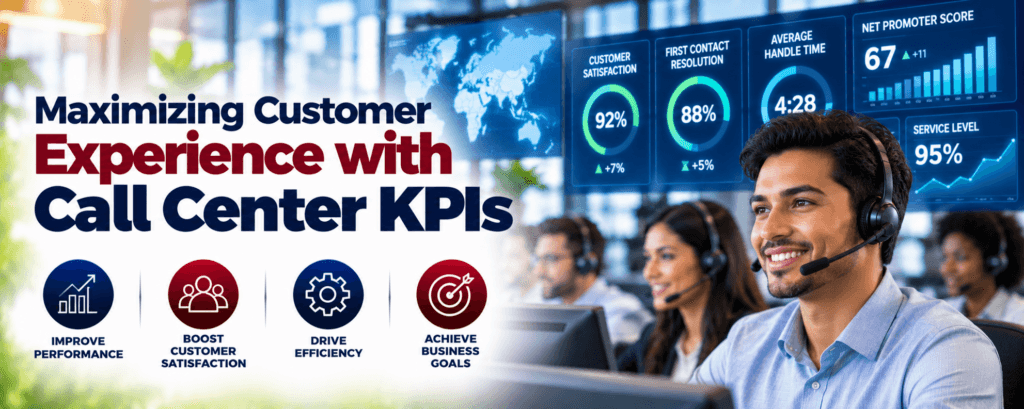
How do you know if your outsourced contact center is delivering exceptional customer service? Are agents resolving issues efficiently? Are customers satisfied with their interactions? And is your outsourcing investment producing measurable results?
The answers can be found in Contact Center Key Performance Indicators (KPIs)—essential metrics that help businesses evaluate customer satisfaction, agent productivity, operational efficiency, and overall service quality.
In today’s competitive business environment, monitoring the right KPIs is critical to building successful outsourcing partnerships. Modern contact centers combine experienced agents, advanced analytics, and AI-powered technology to track performance, identify opportunities for improvement, and deliver consistently positive customer experiences.
Whether your business operates an internal support team or works with an outsourced contact center, understanding these metrics can help improve service quality, control operating costs, and strengthen customer loyalty.
The 10 Most Important Contact Center KPIs
1. First Contact Resolution (FCR)
初回対応解決率(FCR) measures the percentage of customer issues successfully resolved during the initial interaction without requiring additional customer follow-up.
A high FCR rate indicates that agents have the knowledge, training, and resources necessary to address customer concerns efficiently.
Benefits of improving FCR include:
より高い顧客満足度
Fewer repeat contacts
Lower operating costs
Improved agent productivity
Stronger customer retention
For omnichannel contact centers, FCR should account for customer interactions across phone, email, chat, and other communication channels.
Why it matters: Resolving customer issues the first time reduces frustration and demonstrates that your contact center is capable of delivering effective support.
2. 平均処理時間(AHT)
平均処理時間(AHT) measures the average amount of time agents spend handling customer interactions, including conversation time, hold time, and after-contact work.
AHT helps businesses evaluate operational efficiency, staffing requirements, and overall contact center productivity.
However, shorter interactions do not always produce better customer experiences.
Agents who rush through conversations may fail to resolve customer issues completely, resulting in repeat contacts and lower satisfaction scores.
Successful contact centers balance AHT with other important metrics, particularly First Contact Resolution and Customer Satisfaction.
Why it matters: Monitoring AHT helps identify opportunities to improve workflows, agent training, and technology without sacrificing service quality.
3. 顧客満足度(CSAT)
顧客満足度(CSAT) measures how satisfied customers are with a specific interaction, service experience, or support outcome.
Contact centers typically collect CSAT feedback through post-interaction surveys delivered by phone, email, or text message.
Customers may be asked to rate their experience using a numerical scale or satisfaction categories.
CSAT provides valuable insights into:
Agent professionalism and communication
Issue resolution effectiveness
Customer expectations
Service consistency
Areas requiring improvement
Businesses should evaluate CSAT trends alongside survey response rates and other performance indicators to develop a more complete understanding of customer sentiment.
Why it matters: CSAT offers direct customer feedback that can guide improvements in training, processes, and overall service delivery.
4. ネットプロモータースコア(NPS)
ネット・プロモーター・スコア(NPS) measures customer loyalty and willingness to recommend a company to others.
Customers are typically asked:
“On a scale of 0 to 10, how likely are you to recommend our company to a friend or colleague?”
Responses are grouped into three categories:
Promoters (9–10): Customers who are highly likely to recommend the business.
Passives (7–8): Generally satisfied customers who may be less enthusiastic.
Detractors (0–6): Customers who are less likely to recommend the company.
NPS is calculated by subtracting the percentage of detractors from the percentage of promoters.
Although NPS reflects broader customer loyalty rather than the quality of a single contact center interaction, it can help businesses evaluate how customer service contributes to long-term brand relationships.
Why it matters: Tracking NPS alongside operational metrics helps organizations understand how customer experiences may influence retention, referrals, and future growth.
5. サービスレベル
サービスレベル measures the percentage of incoming customer interactions answered within a predetermined time threshold.
For example, a contact center might establish a target of answering 80% of eligible incoming calls within 20 seconds.
Service-level objectives should reflect customer expectations, business requirements, and the complexity of the support program.
Strong service levels can contribute to:
Reduced customer wait times
Improved accessibility
Better customer satisfaction
More consistent operational performance
Greater confidence in the support experience
Businesses should also confirm how their outsourcing partner calculates service level, including the treatment of abandoned calls and other exceptions.
Why it matters: Consistent service levels demonstrate that customers can reach support representatives within reasonable timeframes.
6. Call Abandonment Rate
Call Abandonment Rate measures the percentage of incoming callers who disconnect before speaking with an agent.
High abandonment rates may indicate excessive wait times, inadequate staffing, confusing call routing, or ineffective queue management.
To reduce abandonment, contact centers may implement:
Improved workforce forecasting
More effective staffing schedules
インテリジェントな通話ルーティング
Callback options
Clear queue announcements
AI-powered self-service solutions
When reviewing this KPI, businesses should distinguish between customers who abandon during meaningful wait periods and very short calls that may reflect dialing errors or other circumstances.
Why it matters: Reducing avoidable abandonment helps prevent missed service opportunities, customer frustration, and potential lost revenue.
7. 平均応答速度(ASA)
Average Speed of Answer (ASA) measures the average time callers wait in a queue before reaching a live agent.
ASA provides an important indication of staffing efficiency and contact center responsiveness.
Unlike Service Level, which evaluates the percentage of interactions answered within a defined threshold, ASA focuses on the average waiting time for answered calls.
Businesses should monitor ASA alongside abandonment rates and service levels to evaluate the overall accessibility of customer support.
Why it matters: Lower and more consistent wait times can improve the customer experience and reduce frustration before conversations even begin.
8. エージェントの生産性
Agent Productivity evaluates how efficiently customer support representatives use their available time while maintaining appropriate service standards.
Common productivity measurements include:
Interactions handled per hour
Schedule adherence
Occupancy rates
After-contact work time
Quality assurance scores
Resolution performance
Productivity should never be measured solely by the number of calls handled.
An agent who resolves complex customer issues thoroughly may deliver greater business value than one who processes more interactions but generates repeat contacts.
AI-powered agent assistance, automated documentation, and integrated knowledge management systems can help improve productivity while supporting service quality.
Why it matters: Balanced productivity metrics help contact center managers optimize staffing, identify training opportunities, and improve operational performance.
9. Overall Resolution Rate
Overall Resolution Rate measures the percentage of customer issues successfully resolved within a defined measurement period, regardless of whether resolution required one or multiple interactions.
This KPI complements First Contact Resolution by providing a broader view of problem-solving effectiveness.
For example, a technical support issue may require escalation to a specialist before being successfully resolved.
Although the issue would not qualify as first-contact resolution, it could still contribute positively to the overall resolution rate.
Tracking both metrics helps businesses distinguish between immediate resolution efficiency and ultimate service effectiveness.
Why it matters: Customers expect their problems to be solved. Monitoring overall resolution performance helps ensure that complex issues receive appropriate attention and follow-through.
10. Employee Satisfaction (ESAT)
Employee Satisfaction (ESAT) measures agent morale, workplace engagement, and overall job satisfaction.
Employee experience is an important component of successful customer service operations.
Agents who receive effective training, supportive management, appropriate technology, and reasonable workloads are better positioned to provide consistent customer assistance.
Businesses can evaluate employee satisfaction through:
Confidential employee surveys
Agent feedback programs
Employee retention trends
Coaching and development participation
Workplace engagement assessments
High employee turnover can increase recruiting and training expenses while negatively affecting service consistency.
Why it matters: Supporting contact center employees can improve retention, strengthen service quality, and contribute to more positive customer experiences.
How AI and Advanced Analytics Improve Contact Center KPIs
Modern contact centers increasingly rely on artificial intelligence, automation, and advanced analytics to monitor performance and improve customer interactions.
AI-enabled technology can help management teams identify service trends, evaluate agent performance, and detect potential problems before they become widespread.
Important applications include:
Real-Time Agent Assistance
AI-powered tools can provide agents with relevant knowledge, suggested responses, and troubleshooting guidance during customer interactions.
Automated Quality Assurance
Speech and text analytics can evaluate larger volumes of customer interactions, helping supervisors identify coaching opportunities and potential compliance concerns.
Predictive Workforce Management
Advanced forecasting tools can help contact centers anticipate interaction volumes and optimize staffing schedules.
Customer Sentiment Analysis
AI-assisted analytics can identify potential frustration, satisfaction trends, and recurring service issues across communication channels.
Automated Documentation
AI-generated interaction summaries and workflow automation can reduce administrative tasks and improve agent efficiency.
While these technologies offer significant opportunities, successful implementation requires appropriate oversight, data protection, and ongoing performance evaluation.
The most effective contact centers use AI to support skilled agents—not simply replace meaningful human interactions.
Using KPIs to Improve Outsourced Contact Center Performance
Tracking KPIs is only the first step toward building a high-performing customer support operation.
Businesses must also establish clear performance expectations, review results regularly, and work collaboratively with outsourcing partners to address opportunities for improvement.
Establish Clear Performance Benchmarks
Before launching an outsourcing program, define measurable service objectives and document them in appropriate service-level agreements (SLAs).
Benchmarks should reflect your industry, customer expectations, interaction complexity, and operational priorities.
Balance Efficiency With Customer Satisfaction
No single KPI provides a complete picture of contact center performance.
For example, aggressively reducing Average Handle Time may negatively affect First Contact Resolution and Customer Satisfaction.
A balanced scorecard should incorporate customer experience, operational efficiency, quality, and employee performance.
Review Performance Consistently
Regular reporting and operational reviews help identify trends, recognize improvements, and address emerging challenges.
Dashboards should provide meaningful visibility into performance without overwhelming management teams with unnecessary data.
Invest in Agent Training and Coaching
Performance analytics should support continuous employee development.
Targeted coaching, knowledge management, and effective training programs can help agents improve both efficiency and customer satisfaction.
Adjust KPIs as Business Needs Evolve
Customer expectations, technology, products, and business objectives change over time.
Regularly reviewing performance targets helps ensure that contact center operations remain aligned with your company’s long-term goals.
Why KPI Transparency Matters When Outsourcing
Selecting an outsourced contact center involves more than comparing hourly rates or staffing capabilities.
Businesses should also evaluate whether prospective agencies can provide accurate, consistent, and transparent performance reporting.
A qualified outsourcing partner should be able to demonstrate:
Clearly defined performance metrics
Reliable reporting and analytics systems
Regular operational review meetings
Documented quality assurance procedures
Effective escalation and corrective-action processes
Appropriate data security and compliance controls
A commitment to continuous improvement
When contact center performance is measured consistently, businesses gain greater visibility into service quality, operational costs, and the overall value of their outsourcing investment.
The right outsourcing partner should function as an extension of your business, with shared accountability for customer experience and long-term success.
Find a High-Performing Contact Center With Worldwide Call Centers
にて 世界中のコールセンター, we understand that successful outsourcing requires more than competitive pricing.
Businesses need reliable contact center partners with experienced agents, effective management, advanced technology, and a demonstrated commitment to customer satisfaction.
Our Senior Advisors help companies identify qualified outsourcing agencies capable of supporting their operational objectives and customer experience requirements.
~を通じて WCC Network, we connect businesses with carefully vetted contact center providers offering services such as:
インバウンドカスタマーサポート
Technical assistance and help desk services
Outbound sales and lead generation
Omnichannel customer communications
Back-office processing and BPO
AIを活用した顧客体験ソリューション
Our advisory process begins with understanding your business requirements, expected interaction volumes, performance objectives, technology needs, and budget.
We then introduce you to a shortlist of qualified agencies that align with your requirements, helping you evaluate potential partners with greater confidence.
Our advisory services are provided at no cost or obligation to your business.
Worldwide Call Centers is compensated through commissions paid by participating agencies, allowing clients to benefit from our outsourcing expertise without separate consulting fees.
Start Improving Your Customer Experience Today
Contact Center KPIs provide the foundation for evaluating customer satisfaction, improving operational efficiency, and measuring the success of outsourced customer support.
By monitoring the right metrics and selecting an experienced outsourcing partner, businesses can improve service consistency, strengthen customer relationships, and achieve better long-term results.
無料相談や詳細情報の請求をご希望の方は、今すぐワールドワイド・コールセンターまでお問い合わせください!
呼び出し +1.719.368.8393 または speak with our Senior Advisors お客様のアウトソーシングに関するご要望についてご相談させていただきます。
Start outsourcing with Worldwide Call Centers—no cost, no obligation.